Blogs & Podcasts
GAO Quantum Computing Report: How to Close the Post-Quantum Cryptography Readiness Gap
Back to Blogs & Podcasts
14 Apr 2026
Every year on April 14, the global scientific community marks World Quantum Day. The date, 4.14, references Planck’s constant (6.626 × 10⁻³⁴), the fundamental value at the heart of quantum physics. It’s a day to reflect on both the promise and the reality of quantum technology.
Quantum computing will produce scientific breakthroughs in medicine, materials science, and artificial intelligence. It will also break the encryption protecting your most critical data. Financial records, health information, intellectual property, and national security communications were all secured with algorithms designed for a world without quantum computers. That world is ending.
World Quantum Day 2026 is the right moment to ask: Is your organization ready for what comes next?
Classical computers process information as bits: zeros and ones. Quantum computers use qubits, which exist in multiple states simultaneously through a property called superposition. Combined with entanglement and interference, quantum computers solve certain mathematical problems exponentially faster than any classical machine.
That new muscle fundamentally changes how we think about encryption. Most widely used cryptographic algorithms, including RSA and elliptic curve cryptography (ECC), rely on the difficulty of factoring large numbers or solving discrete logarithm problems. A powerful quantum computer breaks those algorithms in a fraction of the time it would take classical hardware.
The encryption protecting your most sensitive data today is built on math problems a quantum computer will soon treat as trivial.
You don’t have to wait for a quantum computer to arrive before you face quantum-era risk. Adversaries are already collecting encrypted data, storing it for the day they have the computing power to decrypt it. Security professionals call this the Harvest Now, Decrypt Later (HNDL) strategy.
HNDL means the threat is not hypothetical. If a nation-state or well-resourced adversary intercepts your organization’s data today, they store it and wait. Health records, financial transactions, classified communications, proprietary designs: anything encrypted with today’s algorithms is at risk once quantum computers reach sufficient capability.
Insider threats add another layer of urgency. Employees with elevated privileges have access to cryptographic systems, keys, or sensitive data pipelines present a risk that compounds as organizations begin PQC migration. Transition periods, when old and new systems run in parallel, create windows of exposure that bad actors inside an organization look to exploit.
The window to act is not a few years from now. It actually opened a few years ago.
Quantum computers draw most of the attention, but a second threat to encryption is active right now. In April 2026, Anthropic released Claude Mythos Preview, an AI model built to find software vulnerabilities autonomously. Its findings should concern every security leader.
Mythos identified over 1,000 critical vulnerabilities across major operating systems and web browsers, many without any human intervention after an initial prompt. Among its findings were weaknesses in the cryptographic implementations of TLS, AES-GCM, and SSH, the protocols protecting the majority of encrypted communications in production today. Exploiting those weaknesses gives attackers the ability to forge certificates, decrypt protected communications, and bypass authentication mechanisms. One vulnerability in OpenBSD had gone undetected for 27 years.
Anthropic launched Project Glasswing alongside Mythos, a coordinated effort to patch these vulnerabilities before hostile actors find them independently. The initiative commits $100 million in model usage credits to help organizations fix the issues. As of this writing, over 99% of the vulnerabilities Mythos has identified remain unpatched.
The risk profile for government agencies and enterprises has become even more acute: the encryption organizations rely on today faces pressure from both sides. AI-powered tools are finding weaknesses in current protocols now. Quantum computers will break the math underlying those same protocols later. Organizations focused only on the quantum horizon are already behind.
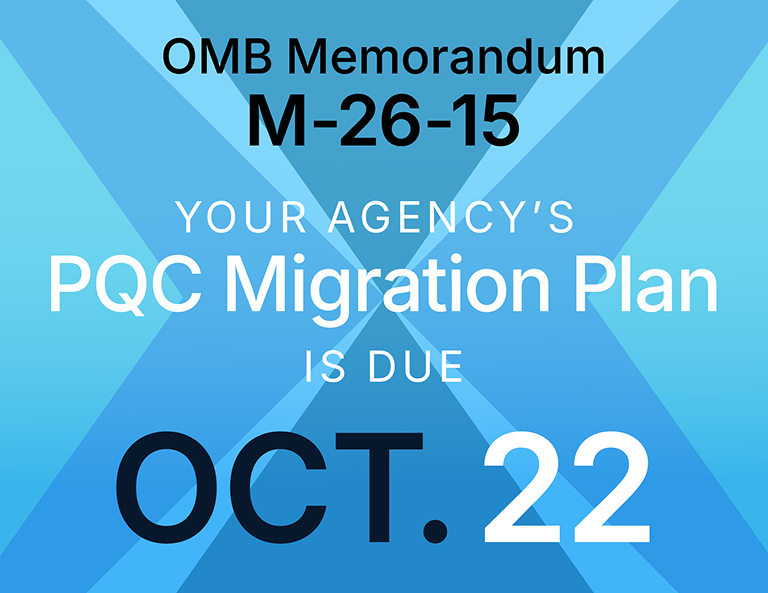
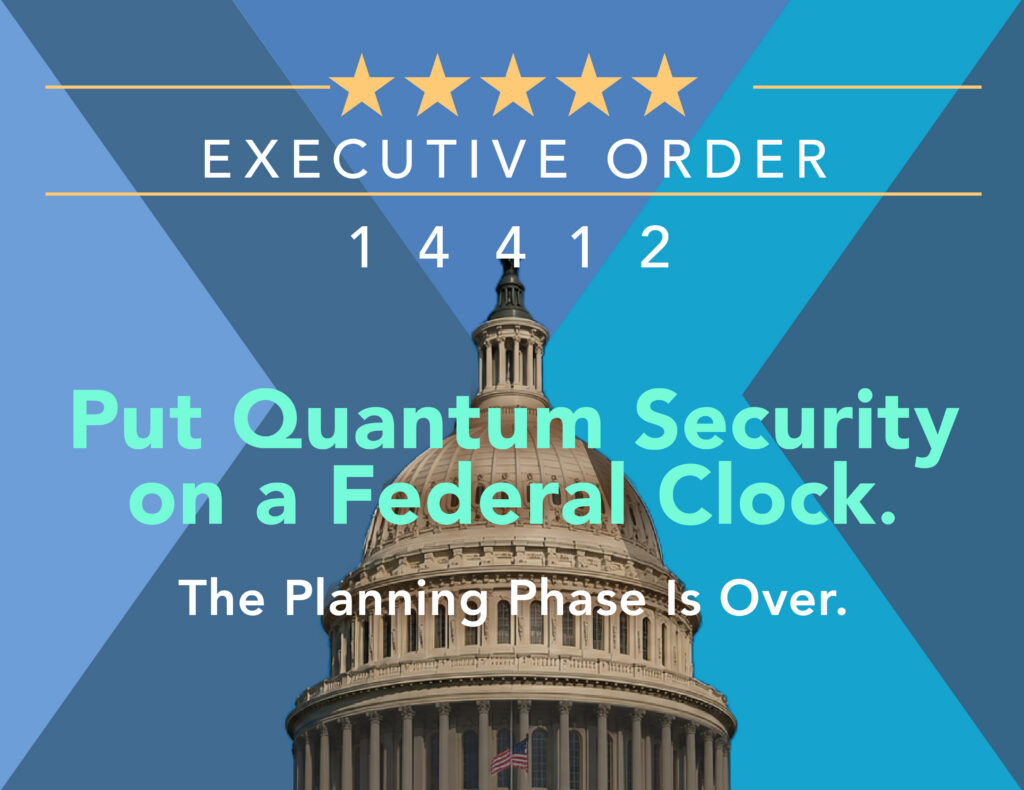
Regulatory bodies have issued clear guidance. The U.S. government has made post-quantum cryptography (PQC) migration a national security priority.
Key directives include:
These aren’t recommendations. They are requirements for federal agencies, and they reflect the urgency every organization, public or private, should feel now.
PQC migration should not simply swap one algorithm for another. It should be a continuous governance imperative. Most enterprise networks run dozens of cryptographic systems, often deployed across different teams, vendors, and generations of infrastructure. Many organizations don’t have a full picture of where cryptography lives across their environment.
Crypto-agility, the ability to update cryptographic algorithms and policies without disrupting operations, is the foundation of a sustainable quantum-safe encryption strategy. Organizations that build for crypto-agility now avoid emergency rip-and-replace cycles later.
Quantum readiness requires three things most organizations haven’t fully addressed:
This is why Gartner recommends organizations establish a Cryptographic Center of Excellence (CCoE), a governance framework for managing enterprise cryptographic assets systematically over time. Encryption is no longer “set it and forget it.” It requires active management.
“The future of encryption is not a math problem, it’s an architecture problem.” – Eddy Zervigon, CEO, Quantum XChange
Most organizations focus on algorithms: which post-quantum standard should we adopt? FIPS 203, 204, 205? ML-KEM, ML-DSA, SLH-DSA? Yes, the algorithm matters, but it is not where most organizations will fail. They will fail on architecture. Here’s why.
In most enterprise and government networks, cryptographic keys are generated, stored, and delivered by the same systems that carry the data those keys protect. If an attacker compromises the data path, the keys are often exposed along with it. This design assumption made sense when encryption was a set-and-forget function. It does not hold when the threat environment requires constant adaptation.
Architecture problems compound during migration. When organizations move from legacy algorithms to post-quantum standards, they typically run both systems in parallel for a period. Without centralized visibility and control, that transition window becomes a blind spot: two cryptographic regimes operating simultaneously, with no single point of governance, no consistent policy enforcement, and no reliable way to confirm what is protected and what is not.
Crypto-agility solves this, but only if it is built into the architecture from the start. Organizations need the ability to update cryptographic policies centrally, push new algorithm configurations across distributed infrastructure, and verify compliance in real-time. That requires separating key management and delivery from the data path, building centralized configuration control, and creating a governance layer that tracks the cryptographic state of the entire network.
This is the architectural shift post-quantum security demands. It is not a one-time project. It is a new operating model for how organizations should manage encryption.
Becoming quantum resilient doesn’t require replacing your entire infrastructure. The right approach adds quantum-safe protection to what already exists, without disruption.
Quantum XChange’s Phio TX® is a cryptographic management platform built for exactly that. Phio TX delivers quantum-safe key management and delivery without requiring a rip-and-replace of existing infrastructure. It separates key generation and delivery from the data itself at the network layer, protecting data-in-motion today while enabling a seamless migration to post-quantum algorithms as standards evolve.
Phio TX is FIPS-validated (CAVP #6060 / CMVP #4850), giving federal agencies and regulated enterprises the compliance assurance they need. It supports crypto-agility, so organizations update algorithms centrally as standards evolve, without disrupting operations.
The Phio TX CMC (Centralized Management Console) extends those capabilities with centralized visibility, configuration management, and node detection across distributed networks. It supports SIEM integration via syslog and gives security teams the operational control needed to manage quantum-safe key delivery at scale.
World Quantum Day is a useful reminder that the quantum era is approaching. The decisions organizations make right now, about inventory, governance, and infrastructure, will determine how prepared they are when it arrives.
World Quantum Day is a useful moment for reflection. What comes after reflection is what matters. The organizations ahead of the quantum threat are not waiting for a better time; they are moving now, while the window is still open.
Have one of our experts show you how Phio TX protects your organization from threats today and the quantum future.
Request Request
a a
demo demo