Blogs & Podcasts, Featured
Phio TX Earns EUCC Certification at EAL2
Back to Blogs & Podcasts
16 Nov 2026By Tom Butta
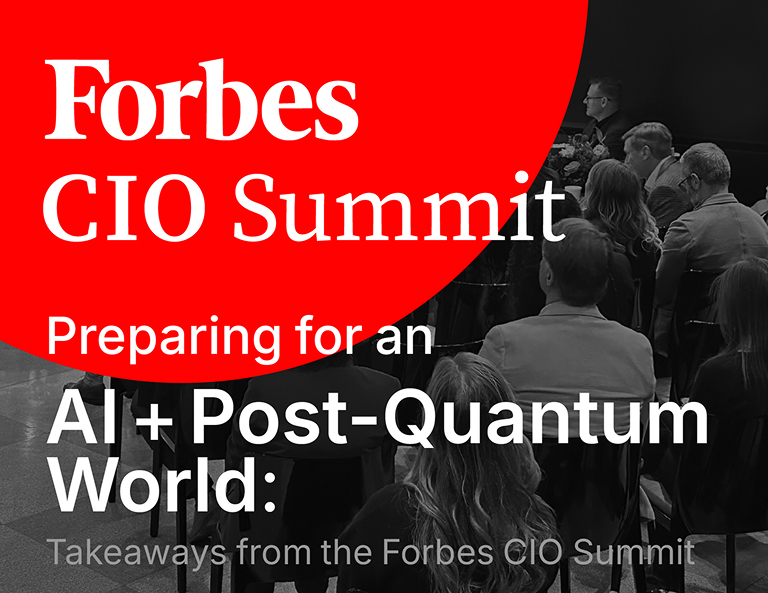
Encrypted data stolen today could be readable by 2029 – or sooner. That is the problem Quantum XChange Chief Executive Officer Eddy Zervigon took on in a fireside conversation with Forbes Senior Editor Alex Knapp at the Forbes CIO Summit on November 11, 2026. It’s also why preparing for a post-quantum world is now a CIO-level priority, not a future research topic. Cryptographically relevant quantum computers able to break today’s public-key encryption have not yet arrived, but adversaries are leveraging advances in AI to accelerate their capture of encrypted data. That’s why regulators have set aggressive compliance dates, and leading organizations have focused on protecting their most sensitive data across their biggest networks.
Watch the full conversation on Forbes, or read on for the six themes and what they mean for CIOs, CISOs, network architects and their teams.
Nearly everything a CIO is accountable for, from customer data and payments to patient records and industrial control, depends on public-key encryption such as RSA and elliptic-curve cryptography. A cryptographically relevant quantum computer (CRQC) running Shor’s algorithm could break both. One could arrive possibly as soon as 2029, a date known as Q-Day. Unlike Y2K, Q-Day will not be announced. It will simply be deployed once an adversarial nation state has the capability.
The policy clock is running. NIST finalized its first post-quantum cryptography (PQC) standards in August 2024 (FIPS 203, 204 and 205), and on October 27, 2026 it published the final NIST IR 8547, which deprecates quantum-vulnerable public-key algorithms after 2030 and disallows them after 2035. Federal guidance issued in June 2026 sets December 31, 2030 for post-quantum key establishment on high value assets and high impact systems, and December 31, 2031 for digital signatures.
Given the rate of advancements in AI and quantum, the reality is most national economies will not be uniformly ready when the threat matures, the U.S. included. Critical infrastructure operators, hospitals, school systems and local governments run long-lived equipment on tight budgets and cannot take networks down for a rebuild. Eddy made this important point to the room: You can prevent a great deal of potential damage by acting now. Getting started is a lot easier and more affordable than most leaders assume. But waiting for a perfect migration plan is a much riskier path.
AI and quantum attack different parts of the problem, which is why the pairing matters. AI makes attackers faster: it speeds up reconnaissance, automates exploitation, and helps sort enormous volumes of stolen data to find what is valuable. Quantum computing, once it matures, removes the lock on data that was protected with classical encryption.
Together, they raise the stakes in four areas:
Defenders can use AI too. The point for CIOs is that the quantum transition and the AI roadmap should be planned together, not in separate silos.
Harvest Now, Decrypt Later describes a simple strategy: adversaries are collecting encrypted data today to decrypt and forge later, once a CRQC exists. The theft happens now. The damage shows up later or sooner if AI keeps advancing the way it has. Regardless, your security tools will not flag the moment the data is decrypted. It’ll just happen.
The practical test involves how long your data must stay confidential. If customer records, intellectual property, health data or deal information must remain private into the 2030s, you are already inside the window of risk. A useful rule of thumb: add the years your data needs protection to the years your migration will take. If the total is longer than the time until a CRQC could arrive, you’re most likely already late.
There is a governance angle too. Freshfields, a global law firm, argues that data protection and cybersecurity laws already require security measures that are “appropriate” to the state of the art, and that regulators or courts could measure companies against NIST’s standards. Its advice is that having no quantum-readiness plan may be a significant liability. For U.S. organizations, the federal timeline above is the clearest signal, and federal contractors and their suppliers are likely to see those dates reflected in requirements. Multinationals should also watch European rules such as DORA and NIS2, where buyers increasingly look for EU-recognized assurance such as EUCC certification. This is not legal advice, so talk to your counsel, but it is a good reason to document your plan.
Decrypting stored data is the headline risk. It is not the only one. The same math that protects confidentiality also protects identity and trust, and the same attack capability puts both at risk:
This is why signature migration has its own deadline, and why the conversation about quantum security needs to include the network itself. The network is where data-in-motion travels, and it is one of the largest attack surfaces you have.
The United States, China and other nations are all investing heavily in AI and quantum. The consequences of an adversary reaching a major breakthrough first have national security and economic impact in the likes of access to protected communications, a lead in the technologies that will shape the next generation of industry, and leverage over allies and supply chains.
With a new Congress taking shape after the midterms, Eddy outlined priorities that have drawn support across party lines in the past:
Are current efforts and funding enough? The GAO findings suggest there is more work to do. Eddy, who testified before the House Homeland Security Committee in December 2025, has been consistent that the technology is available today and the gap is one of execution.
U.S. businesses understand the risk better than they act on it. In the 2026 Entrust and Ponemon Institute study of 4,149 practitioners, 75% expect a quantum computer to break traditional public-key cryptography within ten years (51% within five), yet only 38% are preparing. The top barriers are limited visibility into cryptographic assets (41%), budget (39%) and in-house expertise (38%).
Eddy’s guidance for CIOs comes down to five practical steps:
Phio TX is the Cryptographic Management Platform Quantum XChange built for exactly this. It adds a quantum secure layer to existing infrastructure with no downtime, no new skills or team required,and no impact on network performance. It is FIPS 203 validated and EUCC certified at EAL2 with centralized visibility and controls through a management console, all of which address the barriers CIOs cite most.
You do not have to solve everything at once to make real progress, and you do not have to wait for a perfect plan. Start protecting your existing network infrastructure today, keep your digital transformation roadmap on track, and build the inventory and policy work around it. It is a lot easier, faster, and more affordable than you might think.
Ready to see what it looks like on your network? Request a Phio TX demo, download The CISO and CIO Guide to PQC, or read The Harsh New Reality.
A post-quantum world is one in which quantum computers can break the public-key encryption most organizations use today, such as RSA and elliptic-curve cryptography. Preparing for it means moving to quantum-resistant cryptography and being able to change algorithms as standards evolve.
Start with five steps: rank your data by how long it must stay confidential, protect the network now by adding a quantum secure layer to existing infrastructure, run cryptographic discovery in parallel, make crypto-agility a requirement, and choose validated technology with FIPS 140-3 and FIPS 203 validation. Fold the work into AI and zero-trust initiatives already on your roadmap.
Harvest Now, Decrypt Later is a strategy in which adversaries collect encrypted data today and store it until a cryptographically relevant quantum computer can decrypt it. Data in transit is a primary target.
A cryptographically relevant quantum computer is possibly as soon as 2029, though estimates vary, so the work should start now. NIST’s final IR 8547 deprecates quantum-vulnerable public-key algorithms after 2030 and disallows them after 2035. Federal high value assets and high impact systems are directed to use post-quantum key establishment by December 31, 2030, and post-quantum digital signatures by December 31, 2031. Because migrations take years, organizations with long-lived sensitive data should start now.
AI makes attacks faster and helps adversaries find the most valuable stolen data, while quantum computing could eventually break the encryption protecting it. Together they increase risk to espionage, financial systems, critical infrastructure and national security.
Crypto-agility is the ability to change cryptographic algorithms without rewriting applications or taking systems offline. It matters because post-quantum standards are still evolving and organizations should expect more than one round of updates.
No. Phio TX deploys as a quantum secure layer on existing network infrastructure, with no downtime, no hardware replacement and no impact on network performance.
Have one of our experts show you how Phio TX protects your organization from threats today and the quantum future.
Request Request
a a
demo demo