Blogs & Podcasts
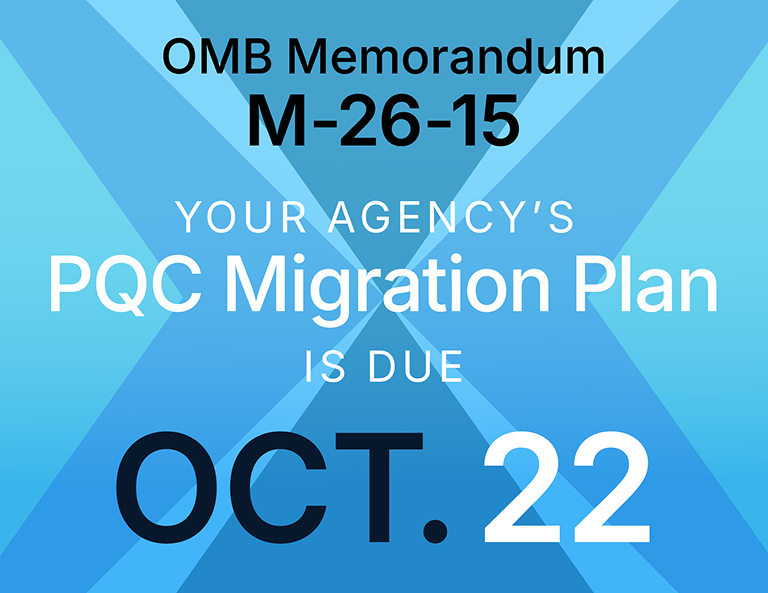
Your PQC Migration Plan Is Due October 22: What OMB M-26-15 Requires
Back to Blogs & Podcasts
12 May 2026
You already know the threat. Your briefings have covered it. Your teams have flagged it. Nation-state adversaries are collecting your agency’s encrypted data right now, banking on quantum computers to break that encryption within the decade.
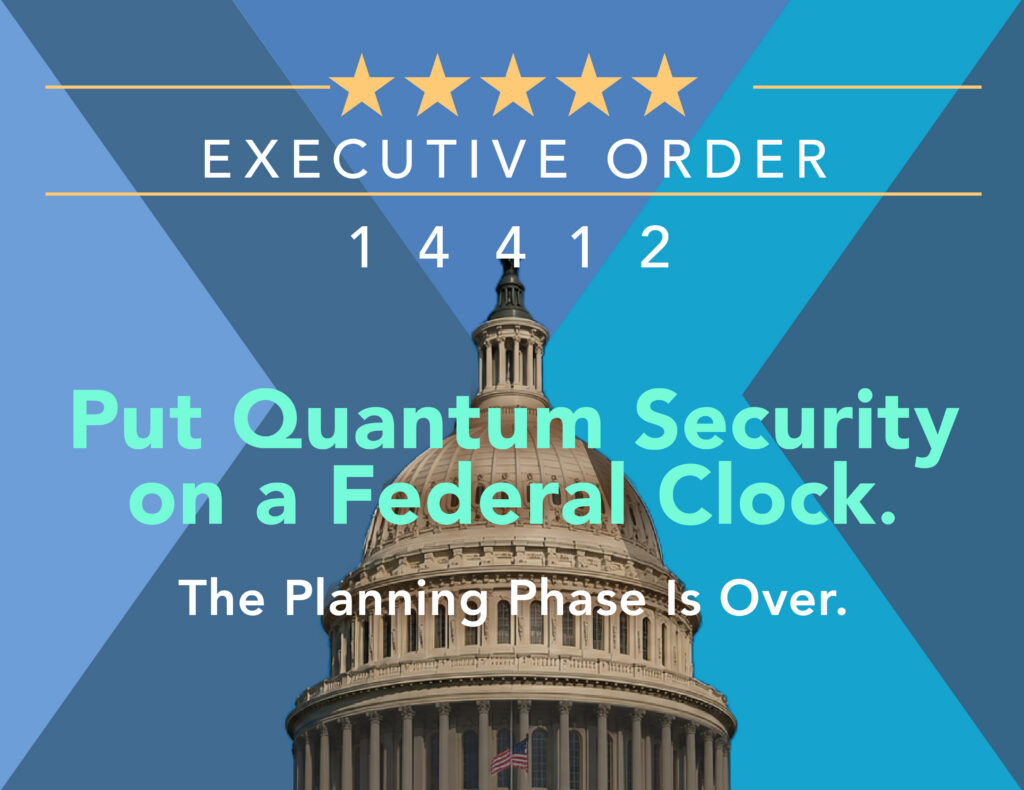
CISA, NSA, and NIST have published guidance. OMB M-23-02 requires cryptographic inventories and migration plans. CNSA 2.0 sets hard algorithm deadlines for national security systems starting in 2030. EO 14144 raises cybersecurity baselines across federal civilian agencies. The mandates are stacking, and the compliance clocks are already running.
So the question for agency leadership is no longer whether to act. It’s whether your organization is structured to execute before the timelines converge.
Harvest now, decrypt later is the term. Adversaries intercept and store encrypted federal traffic today (interagency communications, CUI data flows, mission-critical traffic across NIPRNet and SIPRNet) to decrypt once quantum capability matures. Google set 2029 as its internal post-quantum migration deadline. Research targeting RSA-2048 continues to compress timelines.
Unlike a breach you detect and contain, HNDL collection is silent. There is no alert. No incident report. Every day of inaction adds to the volume of data that will eventually be readable by adversaries. For agencies holding data with decades of intelligence value, the exposure window is already open.
Most federal leaders understand the threat conceptually. The difficulty is translating that understanding into action across environments that were built long before any post-quantum mandate existed.
Federal IT carries constraints commercial networks do not face. Authorization boundaries. FedRAMP requirements. Interagency data-sharing agreements. Legacy systems under long-running ATOs. Procurement cycles tied to annual budget submissions. These realities make encryption changes slow, expensive, and operationally risky.
The common assumption, that post-quantum cryptography is an algorithm swap, underestimates the problem. Encryption is embedded across hundreds of dependencies spanning multiple authorization boundaries, vendor stacks, and classification levels. Changing any single component creates a cascade of reauthorization, testing, and coordination.
Three gaps show up consistently across agencies:
The agencies making real progress have shifted the question. Instead of asking which algorithm to deploy, they are asking how to build an encryption architecture that adapts as algorithms, standards, and threats change.
That concept is crypto-agility: the ability to update cryptographic algorithms and policies without disrupting mission operations or retriggering the full RMF authorization cycle. It separates the key management layer from the data plane so algorithm changes do not cascade across every system boundary.
This is the approach behind Phio TX®, a cryptographic management platform that separates key distribution from encryption. It operates as an overlay on existing network encryptors (Cisco, Fortinet, Juniper, and others), introducing post-quantum protection at the network layer without requiring a rip-and-replace of existing infrastructure or restarting authorization across each system boundary. Phio TX is FIPS-validated (CAVP #6060 / CMVP #4850) and supports the FIPS 203 ML-KEM algorithm.
But the product matters less than the architectural principle. Agencies that build crypto-agile infrastructure now will be positioned to meet CNSA 2.0 deadlines, respond to future algorithm updates, and reduce the HNDL exposure window. Those that treat PQC as a one-time algorithm swap will find themselves re-doing the work every time standards evolve.
OMB M-23-02. CNSA 2.0. EO 14144. CNSS Policy 15. NSM-10. Each mandate sets its own timeline, and those timelines overlap. Waiting for a single “go” signal means falling behind multiple compliance clocks simultaneously.
The leadership question is organizational, not technical. Do you have visibility into your cryptographic dependencies? Is your migration path defined within current ATO cycles and procurement timelines? Can your architecture adapt without a multi-year reauthorization effort every time a standard changes?
The threat is documented. The mandates are published. The execution is what separates agencies that are ready from those that will be catching up.
Harvest now, decrypt later (HNDL) is an active threat where adversaries collect encrypted federal data today to decrypt once quantum computers reach sufficient capability. Federal leadership should care because agency data, including classified communications, CUI, and operational configurations, retains intelligence value for decades. Every day without post-quantum protection increases the volume of exposed data.
OMB M-23-02 requires cryptographic inventories and migration prioritization. CNSA 2.0 sets algorithm deadlines for national security systems starting in 2030. EO 14144 raises baseline cybersecurity requirements across federal civilian agencies. NSM-10 and CNSS Policy 15 add requirements for national security systems. These timelines overlap and are already in effect.
Federal environments carry constraints that commercial networks do not: authorization boundaries, FedRAMP requirements, interagency integrations, legacy systems under long-running ATOs, and procurement cycles tied to annual budget submissions. Encryption is embedded across hundreds of dependencies spanning multiple system boundaries. Changing any single component triggers a cascade of reauthorization, testing, and coordination across those boundaries.
Crypto-agility is the ability to update cryptographic algorithms and policies across an agency’s infrastructure without disrupting mission operations or retriggering authorization cycles. It matters because cryptographic standards will continue to evolve. Agencies that build crypto-agile architectures can respond to new mandates, algorithm updates, and emerging threats without restarting multi-year migration programs each time.
Agencies can start by separating key management from the encryption layer at the network level. This approach, implemented through overlay platforms like Phio TX, introduces post-quantum protection without modifying existing encryptors, triggering the full RMF authorization cycle, or requiring infrastructure replacement. It allows agencies to act within current ATO cycles and procurement timelines.
Talk to our team about building crypto-agile architecture across your federal environment.
Have one of our experts show you how Phio TX protects your organization from threats today and the quantum future.
Request Request
a a
demo demo