Blogs & Podcasts
Executive Order 14412 Put Quantum Security on a Federal Clock. The Planning Phase Is Over.

Back to Blogs & Podcasts
29 Jul 2024By Eric Hay
Most professionals in the security industry understand the pains, challenges, and time it takes to complete a cryptographic transition. It took more than 20 years for the Advanced Encryption Standard (AES) to completely replace Data Encryption Standard (DES) and 3DES. If you haven’t heard the noise, a quantum computer will be able to break RSA-2048, considered the gold standard for Public Key Encryption (PKE), the system that has for years protected our digital universe.
In 2016 the National Institute for Standards and Technology (NIST) warned that all organizations start preparing then for the coming quantum-crypto break. Unfortunately, most have made very little, if any, movement to heed this advice. Our partners at Thales released an industry survey that found 72% of organizations see quantum computing affecting them in the next five years. However, in a similar survey conducted by DigiCert only 56% of organizations surveyed were learning quantum-safe practices.
Unlike Y2K, when there was a definitive deadline and end-date to work against, Y2Q is ambiguous causing too many companies to take a lackadaisical, wait and see attitude to quantum preparedness planning and execution. Many are waiting for the Post-Quantum Cryptography (PQC) selection process by NIST to yield the final standard before they take action.
This is flawed, shortsighted thinking. Consider the following:
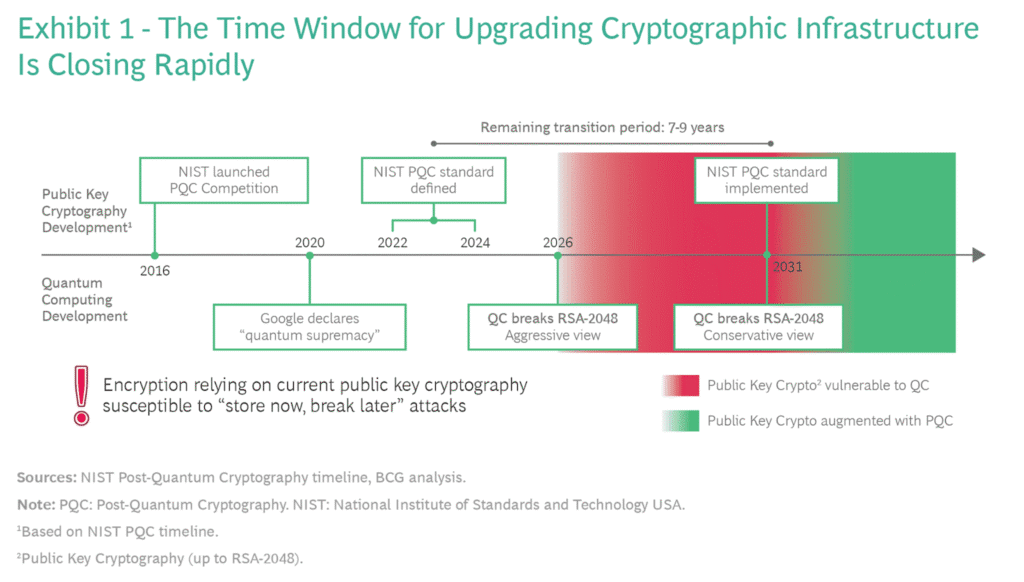
Last week, NIST published the final version of its report titled, Getting Ready for Post-Quantum Cryptography outlining the challenges associated with adopting and using PQC algorithms after the standardization process is complete — which is currently on pace for selection by 2022-24. NIST also cautions that in the best case, another 5-15 more years will be needed after the publication of the cryptographic standards before a full transition is completed.
Boston Consulting Group (BCG), in its March 30, 2021 article, “Ensuring Online Security in a Quantum Future” (see our take on this informative, must-read article here) published the below timeline in response to the NIST PQC project and warned, “This implies that window for upgrading existing infrastructure is seven to nine years — too short for such an ambitious goal.” In concluding, “companies in all industries need to take note now and plan for encryption in the quantum future now.”
Quantum Xchange understands the challenges and complexities of cryptographic transitions can be overwhelming, if not paralyzing. We’ve built a practical and highly scalable, quantum-safe key distribution system that allows organizations to get started now with very little lift or outlay. In fact, our affordable, crypto-agile path to quantum safety can be easily dropped into organizations’ existing crypto infrastructure today.
Phio Trusted Xchange (TX) is a simple architecture overlay that leverages a patent-pending out-of-band symmetric key delivery technology to supplement native encryption with an additional key-encrypting-key (KEK) transmitted independently of the data path. The system supports quantum keys from any source i.e., PQC (all candidate KEM algorithms), QKD, QRNG, or combination. Organizations can easily increase quantum protection levels based on their data inventory requirements and risk tolerance levels without any disruption to the network. Learn more here.
See how Phio TX addresses all of the foreseeable challenges of PQC adoption outlined by NIST in the solutions brief, “A Response to NIST’s Post-Quantum Cryptography Adoption Challenges and Planning Requirements” available here.
Don’t be left behind and vulnerable. Kickstart your cryptographic discovery and inventor with CipherInsights and quantum remediation with Phio TX. Let us show you how we can protect you today.
Have one of our experts show you how Phio TX protects your organization from threats today and the quantum future.
Request Request
a a
demo demo